


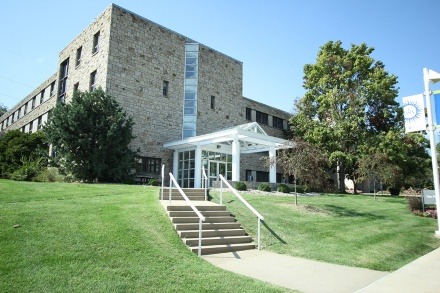
About Student Accessibility Services
Rockhurst University will provide reasonable accommodations, adjustments, and/or auxiliary services to students who are substantially limited in one or more major life activities because of their disabilities. The student must inform Student Accessibility Services that an accommodation, or change in accommodation, is needed. The student is responsible for participating in the interactive process to formulate a reasonable accommodation plan. When a student with a disability requests accommodations based on a clear need, reasonable efforts to provide the accommodation, adjustment, and/or auxiliary service that is deemed effective will be made.
Rights and Responsibilities
To receive disability-related services, students must have a documented or visible impairment as defined by Section 504 of the Rehabilitation Act, the Americans with Disabilities Act (ADA) 1990, and the ADA Amendments Act of 2008. The ADA regulations broadly define impairments to include a wide variety of disorders or conditions affecting any number of body systems, including: the neurological or musculoskeletal systems, special sense organs, respiratory, cardiovascular, reproductive, digestive, genitor-urinary, hemic, lymphatic, or endocrine systems, or the skins. Impairments also include mental or psychological disorders, including: emotional or mental illness and certain learning disorders.
Documentation Guidelines
- A qualified healthcare professional with appropriate credentials and relevant expertise must provide the diagnosis. Documentation should include the following information about the professional:
- Name, title, professional credentials, and area of specialization
- Documentation should be current- i.e., completed within the:
- Last 5 years for learning disabilities (LD), attention-deficit/hyperactivity disorder (ADHD), autism or autism spectrum disorder (ASD), intellectual disability (ID)
- Last 12 months for psychiatric disabilities (non-exhaustive list): anxiety and panic disorders, concussion, depressive disorders, eating disorders (ED), obsessive-compulsive disorder (OCD), personality disorders, post-traumatic stress disorder (PTSD)
- This requirement does not apply to physical or sensory disabilities of a permanent or unchanging nature
- Documentation should include:
- A specific diagnosis, date of diagnosis, and length of contact with the student
- A description of the diagnostic testing done to determine the diagnosis (if relevant to the disability)
- A description of symptoms that meet the criteria for the diagnosis
- Documentation should include an interpretative summary, which:
- Satisfactorily verifies the substantial limitation of one or more major life activities, based on the disability
- Indicates how accommodations would mediate symptoms
- Documentation should be submitted on the official letterhead of the service provider.
SAS relies on documentation from appropriate licensed professionals but will accept alternative documentation in some instances, including an Individual Education Plan (IEP), 504 plan, Summary of Progress (SOP) or other specific information about a student’s education and accommodation history. The student will bear the cost of obtaining documentation. If the initial documentation is incomplete or inadequate, and the student interview does not provide the relevant information needed to make a determination, SAS will have the discretion to request additional information focused on providing the clarification needed to provide the student with reasonable accommodations.
Submit documentation via email, fax, mail, or delivery in person:
Email: sas@rockhurst.edu
Fax: (816)501-4822
Office: 1100 Rockhurst Road, Van Ackeren 200 F- Student Accessibility Services, KCMO 64110
If you encounter a barrier while attempting to access the documentation our office requests, please email sas@rockhurst.edu, explain your situation, and someone will be in contact to assist you.
Alternative Textbooks
Service Animals and Emotional Support Animals
Peer Notetaker Information
The role of note taker is significantly important to ensuring a student who needs accommodations has equal access to the course content. Notetakers should possess the ability to focus and take comprehensive and well-structured notes. In addition, notetakers must maintain confidentiality at all times.
Notetaker Process and Timeline
- Following an instructor's request for a note taker, a student volunteering to serve in that role will complete the Peer Notetaker Contract.
- The contract must be filed with Student Accessibility Services before note-taking services can be initiated and compensation can be provided.
- Provide notes to SAS after each lecture throughout the entirety of the course. A folder is set up where notetakers will scan in their notes for the class.
- Notetakers will be paid by direct deposit or check upon completion of the semester.