

The Biomedical Engineering B.S. at Rockhurst University in Kansas City prepares students for careers in the biomedical device, biotechnology, and health technology industries. Students study biology, chemistry, mechanics, electrical engineering, and biomedical design while developing the technical and analytical skills needed to solve practical health care challenges.
What is Biomedical Engineering?
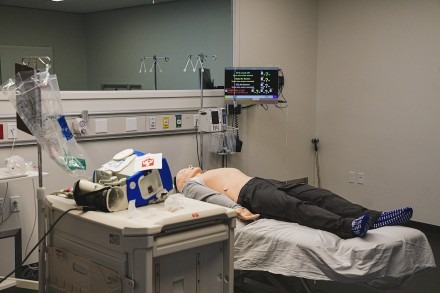
Biomedical engineers apply engineering principles and scientific knowledge to design medical devices, diagnostic equipment, computer systems, and software used in health care and biomedical research. Professionals in this field work in medical device manufacturing, biotechnology companies, research laboratories, hospitals, and other technology-driven organizations.
Biomedical engineering is one of the fastest-growing engineering disciplines. The Biomedical Engineering B.S. at Rockhurst University prepares students to enter this essential and rapidly evolving industry by developing strong foundations in engineering, biology, and applied technology.
Biomedical Engineering Program in Kansas City (Rockhurst–UMKC Partnership)
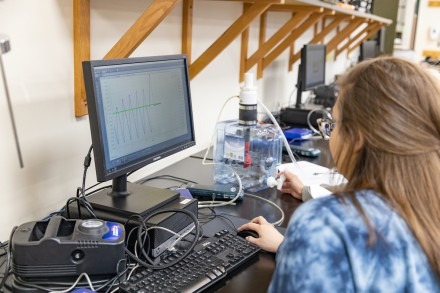
Rockhurst University offers a distinctive biomedical engineering program in Kansas City through a partnership with the University of Missouri–Kansas City (UMKC). Students complete foundational coursework at Rockhurst before taking upper-level engineering classes in UMKC laboratories, gaining access to advanced equipment and specialized engineering expertise.
This collaborative program prepares graduates for careers in biomedical devices, medical technology, and engineering research.
- Partnership with UMKC engineering laboratories in Kansas City
- Strong STEM foundation in biology, chemistry, physics, and engineering
- Hands-on biomedical engineering design experience
- Small class sizes and personalized faculty mentoring
- Preparation for careers in the biomedical device and health technology industries
Biomedical Engineering Program Outcomes
Graduates of the Biomedical Engineering B.S. program pursue careers in the rapidly growing biomedical device, biotechnology, and medical technology industries. Rockhurst students graduate with the engineering, analytical, and laboratory skills needed for medical innovation and health care technology development.
Biomechanics Engineer
Clinical Engineer
Research Engineer
Product Development Engineer
Cellular, Tissue, and Genetic Engineer
Medical Device Engineer
Bioprocess Engineer
Biomedical Data Analyst
Biomedical Engineering Course Map
Degree and class descriptions and requirements can be found by clicking on the course catalog listing below:

Sample Biomedical Engineering Courses
A course in differential calculus and its applications. The emphasis will be on conceptual understanding and exploration. Topics include rates of change, limits, definition of the derivative, differentiation techniques, optimization, velocity and acceleration, implicit differentiation, and related rates.
This course addresses selected basic biological concepts and principles within the framework of the scientific method and modern evolutionary theory. Emphasis is on cellular biology with topics including the basic chemistry, structure, regulation, energy transformation, photosynthesis, respiration, reproduction and genetics of living systems.
Continuous and discrete-time signals and systems, frequency response, Fourier analysis of discrete and continuous signals and systems and use of z, Fourier, Discrete Fourier, and Fast Fourier Transforms.
This course expands on the physics principles developed in introductory physics courses through an in-depth study of mechanics, fluids and thermodynamics as they are applied to the human body.
Additional Degree Info
- The Rockhurst and UMKC partnership gives mechanical engineering students a collaborative, innovative and well-rounded educational experience.
- Upper-level engineering classes are taken at the neighboring University of Missouri-Kansas City to take advantage of their engineering laboratories and expertise. The courses are automatically transferred to the Rockhurst registrar at the end of each semester.
Frequently Asked Questions
How long does it take to earn a biomedical engineering degree?
Most students complete a biomedical engineering bachelor’s degree in four years. In the Rockhurst–UMKC joint program, students complete foundational coursework at Rockhurst University before taking upper-level biomedical engineering courses and laboratories at the University of Missouri–Kansas City (UMKC).
Why study biomedical engineering at Rockhurst University?
Rockhurst University offers a biomedical engineering degree in Kansas City through a partnership with the University of Missouri–Kansas City (UMKC). Students build a strong foundation in biology, chemistry, physics, and engineering at Rockhurst, a renowned Jesuit institution, while gaining hands-on laboratory experience in UMKC’s engineering facilities, preparing graduates for careers in biomedical devices, biotechnology, and health technology.
What can you do with a biomedical engineering degree?
Graduates with a biomedical engineering degree pursue careers in biomedical device development, medical technology companies, biotechnology firms, research laboratories, and health-care innovation.
Is biomedical engineering a good career?
Biomedical engineering is one of the fastest-growing engineering fields, with opportunities in biotechnology, medical devices, prosthetics, diagnostics, and health technology innovation.
Where can biomedical engineers work?
Biomedical engineers work for medical device manufacturers, biotechnology companies, hospitals, research institutions, and government health agencies, focused on improving patient care and medical technology.
What do biomedical engineers design?
Biomedical engineers design medical devices, diagnostic equipment, prosthetics, medical imaging systems, and software used in health care and biomedical research.

Find Your Program
Choose topic to quickly find specific program details