Interdisciplinary Classes Further RU’s Commitment to Career Preparation
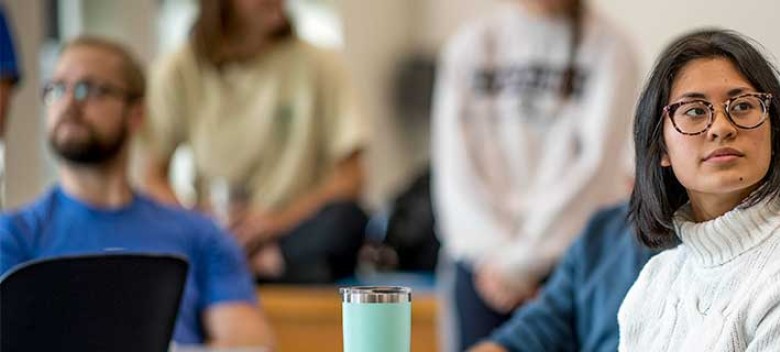
Today’s workplace is diverse in both its composition and responsibilities. Interdisciplinary classes, minors, and majors encourage students to think critically and creatively to properly prepare individuals for this evolving professional world.
Rockhurst’s College of Arts & Sciences built a multi-disciplinary approach and team-teaching into its 2020-2025 strategic plan to incorporate two or more areas of study to prepare students for the more varied careers in today’s global job market.
Focusing on an interdisciplinary approach allows students to learn a variety of academic subjects and abilities that they can apply after graduation to seek innovative solutions to complex problems in both the workplace and life.
Zach Pohlman, ’18, is a Rockhurst and Notre Dame Law School graduate. He triple-majored at RU and credits his success, in part, to how he was encouraged to think differently.
“From the analytical thinking I used in my economics classes to the natural law I learned in my philosophy classes to the difficult texts I navigated in my theology classes, Rockhurst helped prepare me to read and think and write in the way that law school required,” he said.
Educators spend significant time strategizing and collaborating to create these offerings.
For a “Medical Spanish” class, the process of creating an interdisciplinary curriculum lasted for more than two years. The goal was to create a Spanish specialty for, in this case, healthcare jobs, health professionals, and health providers – that include doctors, nurses, medical assistants, and anybody that needs to speak Spanish and communicate to patients.
“There was a societal need even before COVID to provide this to the community,” said Leslie Merced, associate professor of Spanish & chair, Department of Modern Languages & Literatures. “The fact that you are creating bilingual nursing students and bilingual pre-med students will definitely help with the communication aspect of healthcare.”
According to Merced, the courses teach the Spanish language, but also the cultural components of healthcare and what to expect from a patient. She used the example of eye contact and how in some cultures it is common to avoid eye contact with someone “accomplished” and/or holding a degree. It is not a sign of disrespect as it may be in other cultures.
It comes down to teaching respect for the patient, valuing their perspectives, and to think beyond what’s in a textbook.
“It's part of our mission – to create a very complete person,” Merced said.