

The Catholic studies program includes a curriculum that analyzes the rich contributions of Catholicism to human history, culture and thought. The program is ideal for students interested in Catholic theology, Christianity and developing a deeper understanding of Catholic beliefs and how they informed history and impact modern society.

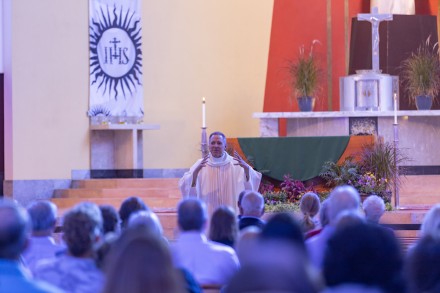
Program Overview
All Rockhurst University students, regardless of major, are invited to participate in the Catholic studies minor. No specific background or previous education is necessary and people of all faiths or persuasions are invited to participate.
Students who wish to complete the Catholic Studies minor will work closely with the program director for the Catholic Studies program. The minor includes a selection of courses from a range of Rockhurst University departments. Students must normally complete a total of 12 upper-division hours to complete the minor (4 courses).
Student Reflections
"I would highly recommend the Catholic Studies minor — the people have been great and the material you cover is extremely interesting. You do not need to be a religious person to enjoy this minor, and it can really open the way you think on a daily basis.” – Whit Tegenkamp
“I loved how each of the films and books from class shed artistic light on a certain aspect of God. No message was pushed down your throat, but professors presented the story in a way that lets the reader/viewer decide what the truth is." – Maria Kramer
Learning Outcomes
- Ability to critically evaluate a range of Catholic ideas and traditions, narratives and expressions.
- Recognition of how Catholic traditions, along with philosophy and theology, play important roles in local, national, and global issues and events.
- Appreciation for the diversity of perspectives within Catholicism, Christianity and other religious traditions.
Program Outcomes
The Catholic studies minor complements many other areas of study, giving students a well-rounded education that prepares them for various career opportunities.
Theology
Law
Government
Education
Course Map
Degree and class descriptions and requirements can be found by clicking on the course catalog listing below:

Popular Courses
A philosophical inquiry into the rationality of religious belief, focusing in particular on two questions: 1) Does God exist? and 2) Is religious belief rational? Discussion of these questions normally involves discussion of the following issues: arguments for the existence and nature of God; the problem of evil; the questions of immortality, religious pluralism, and the relationship between religion and morality; the nature of religious experience; faith vs. reason; religion vs. science; etc.
This course explores the relationship between law, justice and society from the ancient world until the 17th century. The course will emphasize law as it developed in medieval Europe, particularly the revival of Roman law and its influence. Students will also examine methods of dispute resolution and social control in the pre-modern world, both formal methods, in the development of criminal justice systems, and informal methods, such as the vendetta. Topics will also include women in pre-modern law, the development of laws of proof and evidence, incarceration and punishment.
The course covers the development of perspectives held by Christians throughout the ages wrestling with God’s omniscience, omnipotence, and benevolence in the face of the human experience of suffering and evil. Thus, the course treats foundational Catholic theology in depth, and subsequently various Protestant points of view, as well as Eastern Orthodox beliefs and perspectives. Primary focus is on the articulations of Augustine and Thomas Aquinas and their respective theodicies, supplemented by that of Irenaeus (recently proclaimed a Doctor of the Catholic Church) and other Eastern Christians. Later responses, such as those of Leibnitz, are also addressed.
This course will survey Irish writing in English, with emphasis on the literature of the early 19th century to the present. It will consider, in particular, works of major figures such as James Joyce, W.B. Yeats, G.B. Shaw, Seamus Heaney, and Brian Friel, as well as the contexts of Irish history and cultural politics.
Studies of the representative writers of the Spanish Golden Age (1500-1680), which may include the “Lazarillo”; plays by Lope de Vega, Tirso de Molina, Miguel de Cervantes, and Calderón; and selections from Santa Teresa, San Juan de la Cruz, Fray Luis de León, Quevedo and Góngora.
Degree Info
- The Catholic studies minor is part of the Center for Interdisciplinary Studies.

Find Your Program
Choose topic to quickly find specific program details